
Currently, many people have implemented Large Language Models (LLMs) for various tasks as artificial intelligence agents. However, most still use general-purpose agents; artificial intelligence agents are often viewed as a “Swiss Army knife” that can be applied to all tasks, when in reality they deliver more optimal results when fine-tuned for a specific task. Agentic AI is a new paradigm for implementing artificial intelligence where there are several layers of artificial intelligence—comprising AI agents with specific capabilities—that collaborate to perform a task autonomously.
For example, we can ask an AI agent to create a project proposal; the agent will automatically execute the steps required to create a proposal (i.e., collecting data, formulating hypotheses, structuring the format, etc.). With the Agentic AI paradigm, these steps are not performed by a single agent but are distributed among several agents with specialized capabilities, where each agent communicates with one another to complete the task. For instance, in the example of creating a project proposal, several agents would be used, such as a manager agent, a research agent, and a writer agent, each with their own specific tasks: the manager agent determines the necessary steps, the research agent gathers data, and the writer agent defines the format.
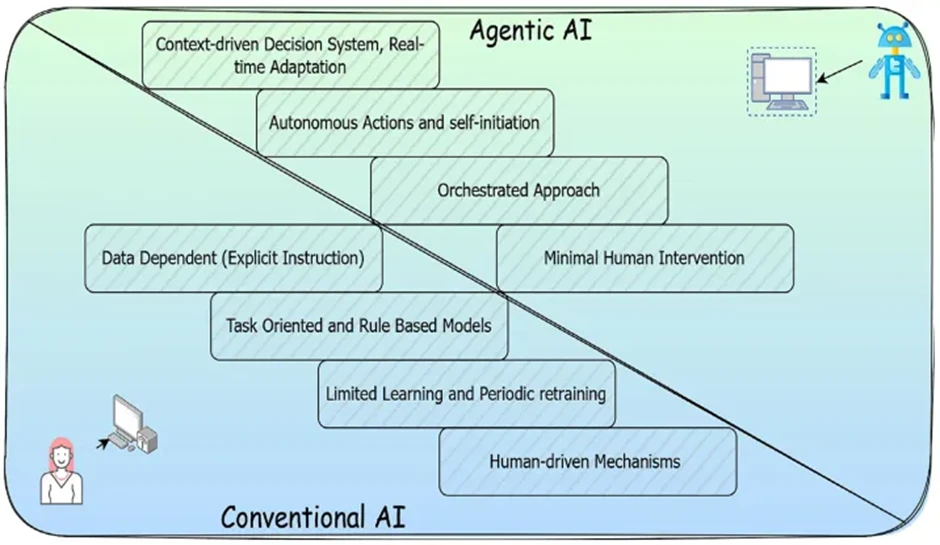
(Source: https://www.frontiersin.org/journals/medicine/articles/10.3389/fmed.2025.1753443/full)
The image above illustrates the difference between the Agentic AI paradigm and traditional artificial intelligence agents. A user of a traditional AI agent would provide detailed input to the agent every time it needs to perform a task. In the Agentic AI paradigm, the user provides an input in the form of a desired goal; then, the layers of the artificial intelligence agents communicate with one another and perform their tasks autonomously to achieve that goal. Simply put, an artificial intelligence agent can complete a specific task, whereas Agentic AI implements various artificial intelligence agents within a standard operating procedure (SOP).
The Agentic AI paradigm can be implemented across various fields of science; for example, Amazon has developed a healthcare service platform based on Agentic AI called Amazon Connect Health. According to a Reuters article, Amazon, through Amazon Web Services, launched the Amazon Connect Health platform—an AI-based system designed to automate administrative tasks in the healthcare sector, such as patient scheduling, data verification, clinical documentation, and medical coding. This platform utilizes specialized data-driven learning techniques and healthcare guidelines, and undergoes a multi-layered evaluation process to ensure safety and accuracy, including the involvement of clinical staff in the verification process. Additionally, the system can transcribe doctor-patient conversations, compile clinical notes in real-time for review, and generate summaries that are easy for patients to understand. An evidence mapping feature is also provided to enhance transparency by linking AI outputs to their original data sources, such as medical records or conversation transcripts. This implementation of Agentic AI has the potential to reduce the significant administrative burden on healthcare workers, allowing medical staff to focus more on clinical care for patients.
In conclusion, the Agentic AI paradigm represents a significant evolution in the utilization of artificial intelligence, moving from a general-purpose single-agent approach toward a structured, collaborative, and goal-oriented multi-agent system. By dividing tasks among agents with specific capabilities that interact autonomously, Agentic AI can enhance efficiency, accuracy, and scalability in solving complex problems. Its implementation in the healthcare sector, such as on the Amazon Connect Health platform, demonstrates the potential to optimize administrative processes, which will indirectly improve the quality of clinical services. Agentic AI presents an opportunity for a more adaptive, efficient, and patient-centered transformation of the healthcare system.
References:
https://link.springer.com/article/10.1007/s10462-025-11422-4
https://www.nature.com/articles/s41746-026-02517-5
https://www.frontiersin.org/journals/medicine/articles/10.3389/fmed.2025.1753443/full