
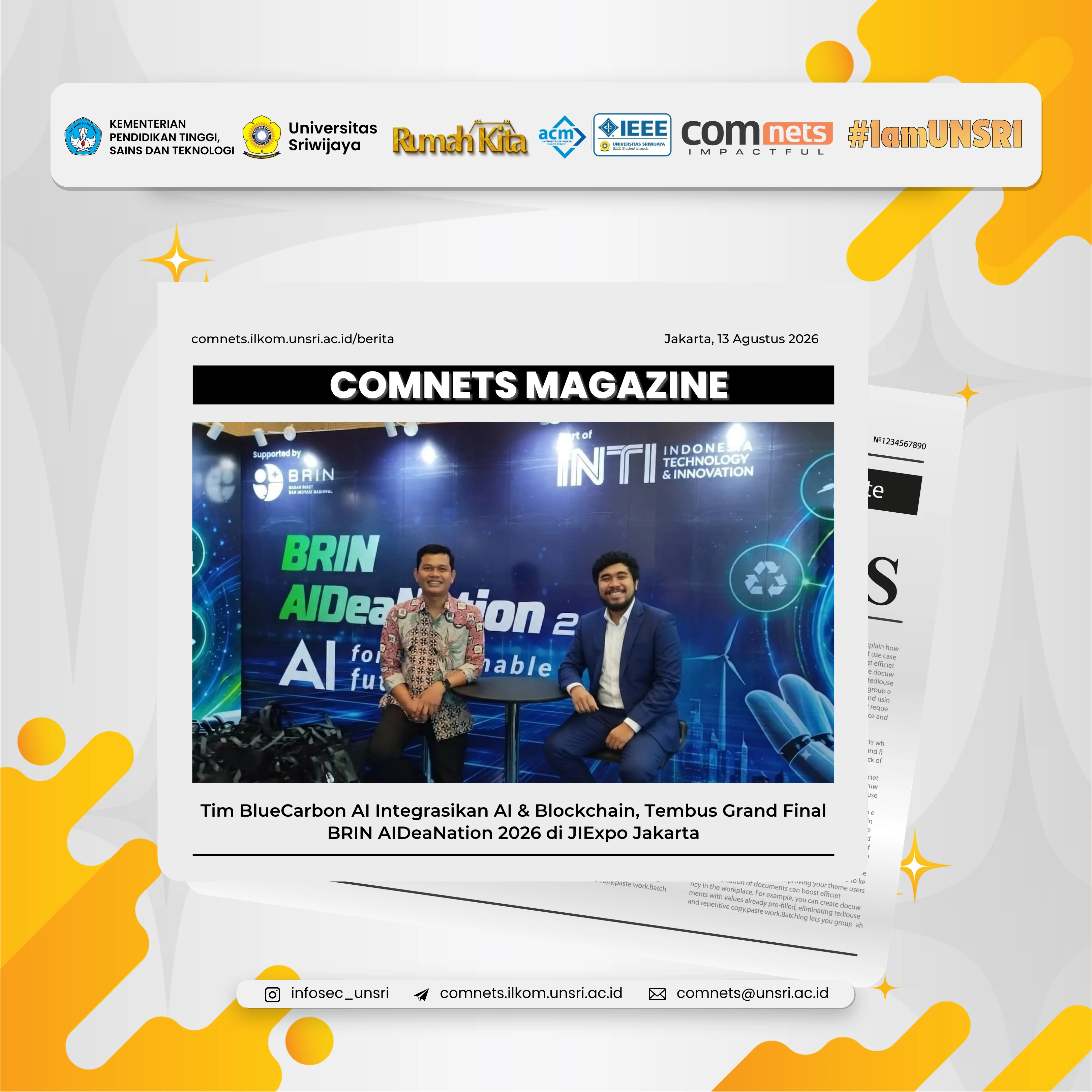
JAKARTA — Akhmad Khudri, M.Kom., a doctoral student at the Faculty of Engineering, UNSRI, who is also a lecturer at Bina Darma University (serving as Lead System & AI Architect), along with Dodi Setiawan, S.Kom., M.S.I., a lecturer at Bintan Cakrawala Polytechnic (as team leader), successfully advanced the BlueCarbon AI platform to the Grand Final round and delivered a national pitch at the BRIN AIDeaNation 2026 event. This prestigious event, organized by BRIN’s Electronics and Informatics Research Organization (OREI), took place on August 11–12, 2026, at the AI Stage & AI Pavilion, JIExpo Kemayoran, Jakarta.
With the main theme “AI for a Sustainable Future,” the event brought together dozens of the best Artificial Intelligence-based innovations from universities, research institutions, and startups across Indonesia to address future sustainability challenges.
The BlueCarbon AI innovation is designed to address the coastal ecosystem crisis through a participatory, AI-centered design approach and high-level system infrastructure, with the following stages of idea development:
- Identification of On-the-Ground Issues: Based on data showing the loss of 453.16 hectares of mangroves on Bintan Island, as well as conservation data that has long been manually scattered across various agencies, the team identified the need for a single, integrated intelligence layer.
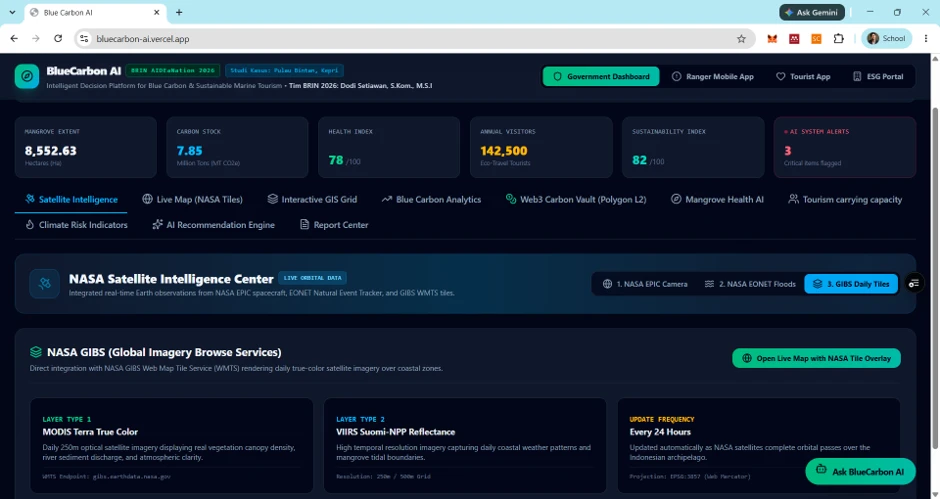
- Application of Appropriate Technology: The solution is designed to be adaptive to coastal constraints, utilizing a tiered satellite imagery strategy (free Sentinel-2 for routine monitoring and Pleiades only for critical areas), solar-powered IoT sensors based on the LoRa network, and an “offline-first” mechanism.
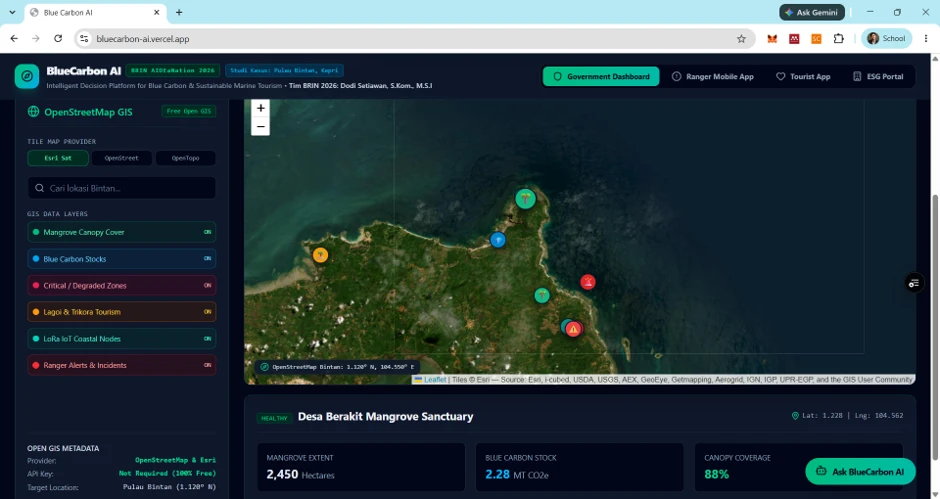
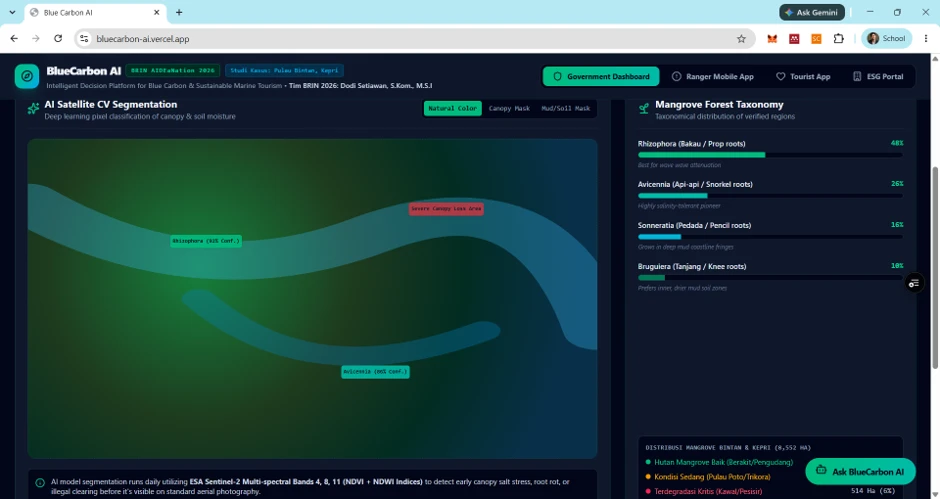
- Development of Multi-Module AI: The system was developed into four main modules: Government Dashboard, Ranger Mobile App, Tourist App, and ESG Dashboard, supported by Computer Vision, a Blue Carbon Estimation Engine, and a Large Language Model (LLM) with Retrieval-Augmented Generation (RAG).
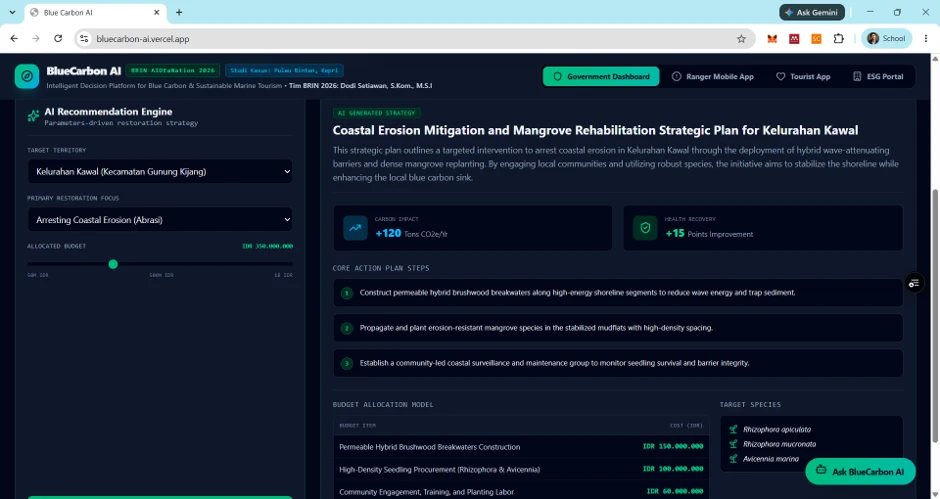
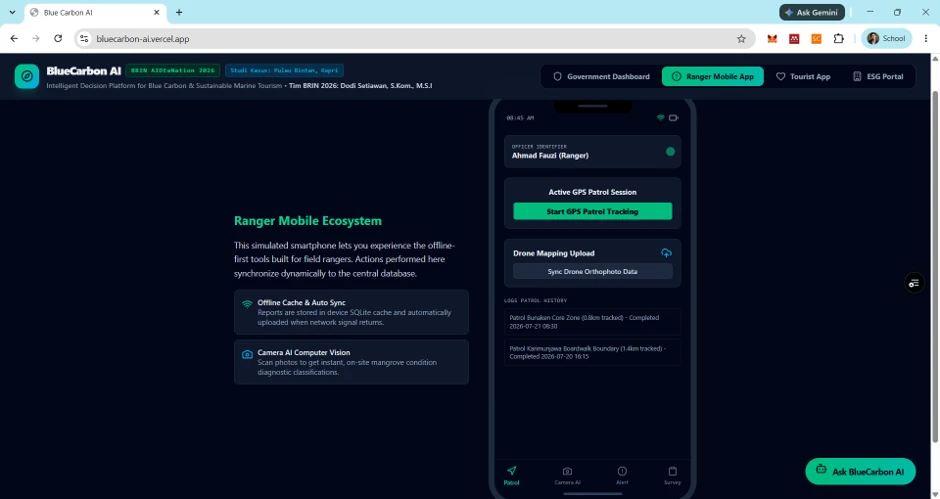
- Mobile Geotagging: Integrates tiered satellite image monitoring (Sentinel-2 & Drone AI), on-device AI inference for mangrove health classification via the Ranger Mobile app, and an “offline-first” mechanism for coastal communities.
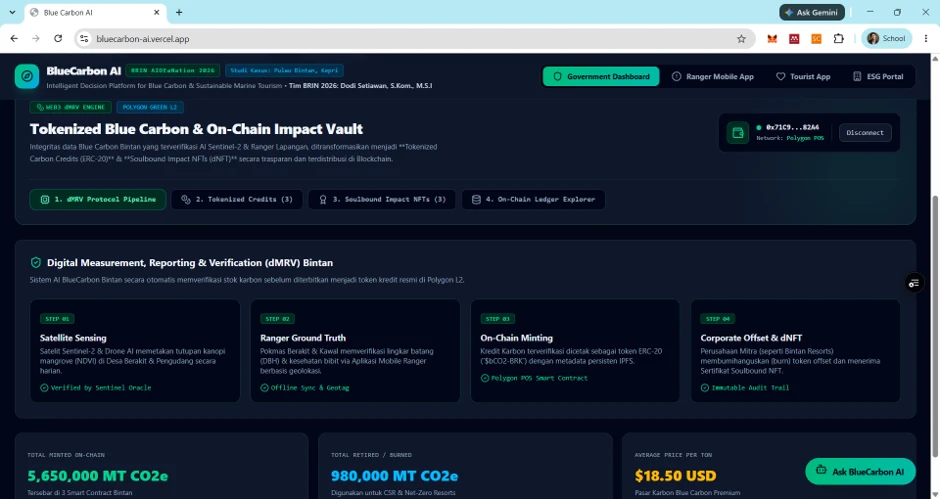
- Web3 Carbon Vault (Polygon L2) Integration: Post-proposal enhancements in the form of a blockchain-based digital Measurement, Reporting & Verification (dMRV) architecture. This aligns with the team’s dissertation research focus, where AI-verified carbon data integrity is directly transformed into Tokenized Carbon Credits (ERC-20) and Soulbound Impact NFTs (dNFTs) on the Polygon Green L2 network in a transparent, immutable, and auditable manner.
During the two-day exhibition and pitch session before a panel of BRIN expert judges and an industry audience, the Web3 Carbon Vault module emerged as one of the main highlights. The judging panel highly commended the team’s boldness in directly integrating the dMRV pipeline into an interactive prototype. Lively discussions also focused on the accuracy of the blue carbon estimation model, which was calibrated using real-world data from local coastal areas.
The on-device AI inference approach in the Ranger App—which allows coastal communities (citizen rangers) to automatically verify mangrove health directly from their phones without relying on an internet connection—also caught the attention of the judging panel.
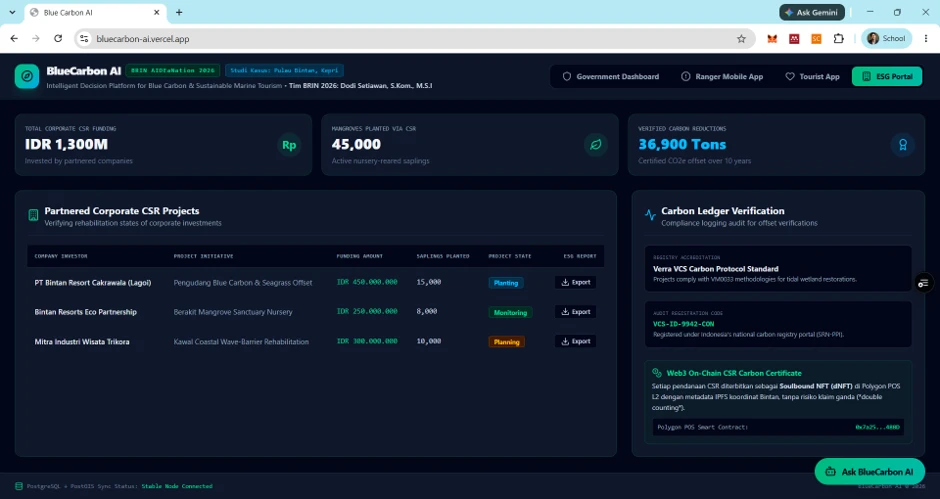
This system demonstrates a complete data flow: starting from satellite mapping in the villages of Berakit and Kawal, field verification by local community groups, the minting of carbon credit tokens on the Polygon POS Smart Contract with IPFS metadata, compliance with ESG values, to the corporate offset mechanism (token burning) that issues Soulbound NFT certificates for corporate partners.
Although competition in the final round was extremely fierce—with strong teams from renowned universities such as ITS and ITB as well as established startups— making it into the ranks of the top national finalists in this BRIN event proves that the quality of research and technological engineering from the two doctoral students at Sriwijaya University—under the guidance of Prof. Ir. Deris Stiawan, Ph.D., IPU., ASEAN Eng, is capable of competing at the highest national level.
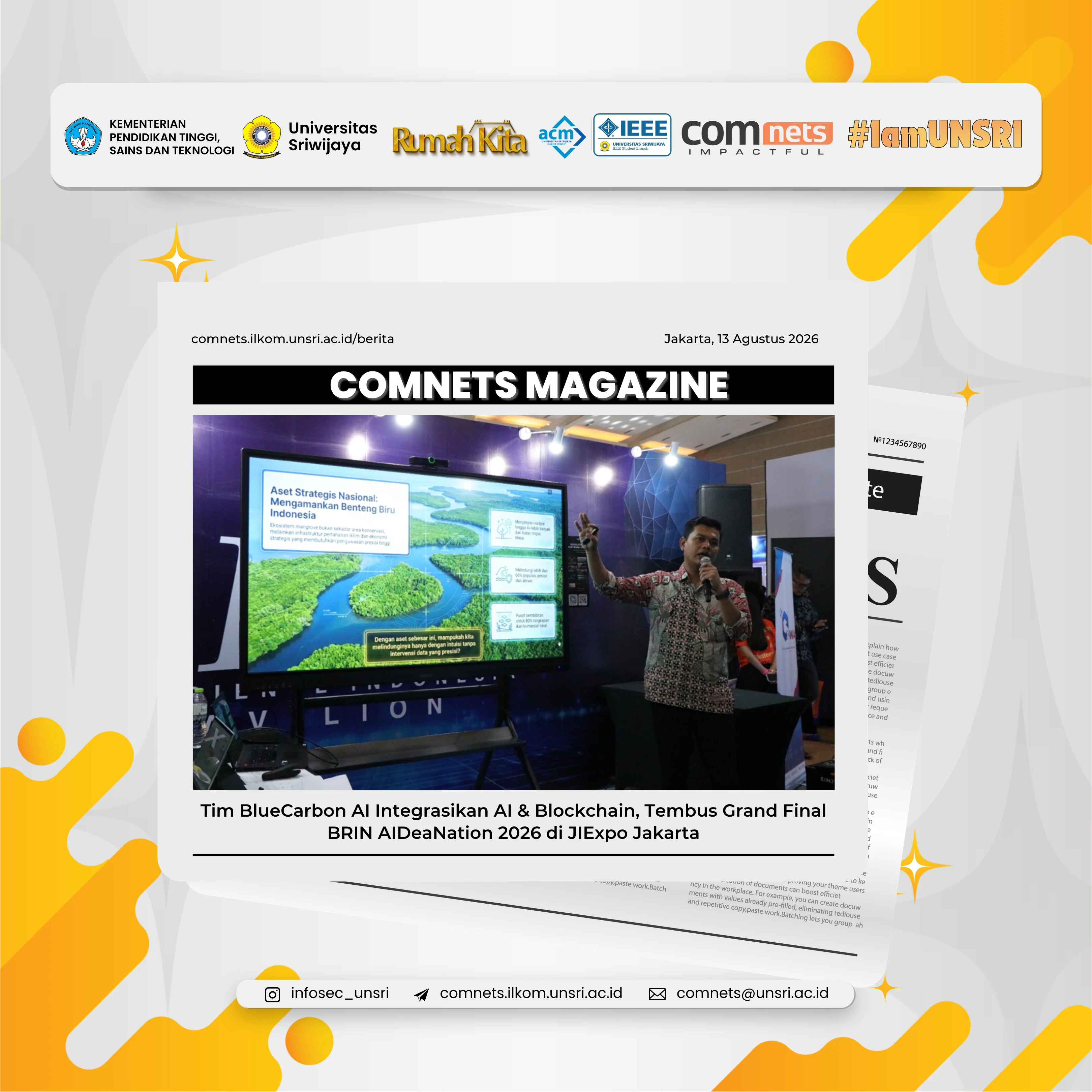
The development of BlueCarbon AI, which combines AI and blockchain, serves as tangible proof of the team’s commitment to delivering practical, industry-standard research to support environmental conservation and the green economy in Indonesia.